

Kitespots Germany
30.07.2026
Written by Lasse
St. Peter-Ording, Büsum and Cuxhaven are must-rides for any North Sea kiter. But no matter how good the spot is, what really matters is the know-how around it: the right directions, the facilities on site and a forecast that actually holds up on the coast. That's exactly what you get here. The German North Sea coast is a proper kite playground: wide tidal flats, big standing areas and steady wind from mostly westerly directions. It's the shallow, waist-deep zones in particular that make this coast a great place to learn to kitesurf, but advanced riders and pros get their money's worth here too. What all the spots have in common is that they're tide-dependent, so if you head out without checking the tide calendar, you'll quickly find yourself high and dry. In return you get flatwater sessions that are hard to beat anywhere in Germany. Here are three classics.
Kitesurfing in St. Peter-Ording
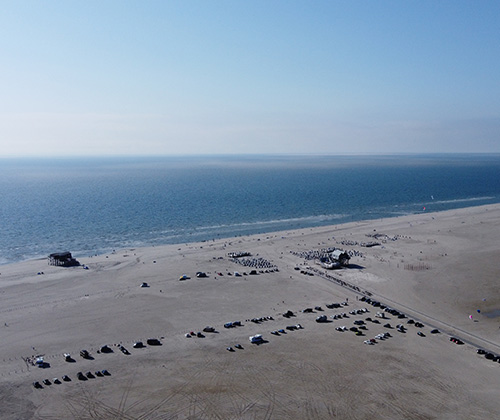
The classic on the Eiderstedt peninsula. Germany's most versatile spot, from beginner zone to speed run. For decades SPO has been the name when it comes to kitesurfing in Germany, not least because the Kitesurf World Cup was held here and one of the scene's biggest test events and watersports expos takes place here every year. The beach is huge, and the riding corridor at Ordinger beach offers plenty of room. What makes the spot so accessible: the North Sea swell breaks over numerous offshore sandbanks and stays moderate as a result, with hardly any real shorebreak. Add to that waist-deep sandbanks and a wide standing area at low tide. One special feature: SPO is the only place in Germany where you're allowed to drive your car straight onto the beach and set up your gear right there.
Important: the designated kite zones must be strictly observed. They lie to the left and right of the swimming area in front of the beach car park and are marked by white and yellow buoys. Kiters and windsurfers also share the area, so being considerate is a must.
For beginners, Böhler beach to the south is often the more relaxed choice: less crowded and rideable in several wind directions. You can usually get on the water there roughly two hours before to two hours after high tide. Advanced riders are better off in Ording, where the wave can be tricky: nothing sorts it out or makes it break in the same spot every time, which makes it unpredictable. And for the really good kiters, it's worth heading out into the wave during a SW storm: you get an almost Cape Town feeling with a perfect kicker to the left.
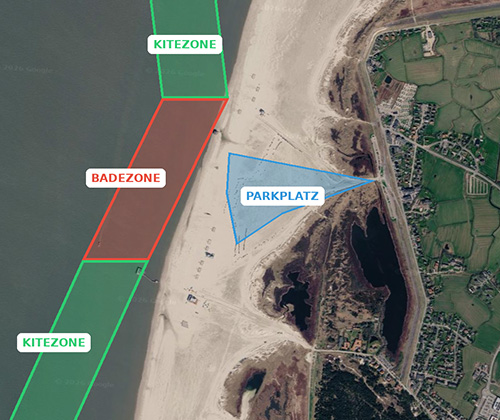
| Directions | Take the A23 to Tönning, then head towards the Eiderstedt peninsula. Around 1.5 to 2 hrs from Hamburg, approx. 1.5 hrs from Kiel, approx. 1.5 hrs from Flensburg. Follow the signs for "Strandparken - Ordinger Strand". |
| Wind | Works in west, north and south winds. |
| Tides | At Böhl, rideable roughly 2 hrs before to 2 hrs after high tide. Check the tide calendar beforehand. |
| Level | Beginner (Böhl) to pro (Ording, wave in a SW storm) |
| Facilities | Several mobile kite schools with courses and gear rental, car parks behind the dike, cafés and accommodation right nearby. |
| Costs | Day beach ticket for the car around €12, annual parking pass €125 incl. VAT, worth it from a few sessions a year onwards. |
Kitesurfing in Büsum
The Perlebucht in Dithmarschen. A hidden gem with a lagoon, arguably the best flatwater spot in the country. Büsum has an ace up its sleeve: the Perlebucht. This man-made lagoon, around 300 m long and 150 m wide, offers mirror-flat water with no current in any wind strength. It's no coincidence that Germany's best kitesurfers train here regularly. Right in front of it there's also a huge, waist-deep area in the North Sea with a gentle mudflat entry, sandy bottom and hardly any stones. That means beginners can learn safely, while pros dial in tricks or throw big air jumps.
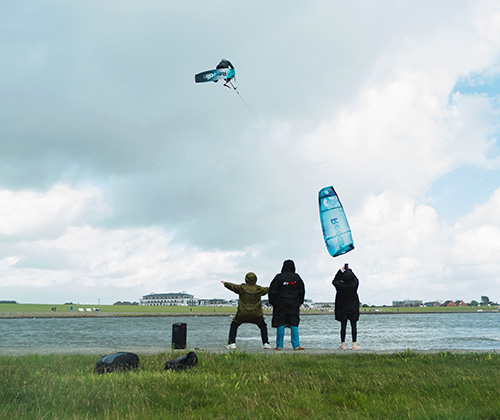
Important: in season you sign in at the kite school beforehand. For the lagoon you need a VDWS licence Level 5 (IKO Level 3). Setting up and packing down happens not on the grass, which is off limits, but only in front of the kite school, where it can get tight when the water is high. Only head onto the bay if you feel confident and stick to and respect the circular pattern in the take-off zone, so nobody gets in each other's way. In east winds there's a fallback spot just a few kilometres away in Büsumer Deichhausen, which makes Büsum almost independent of wind direction.
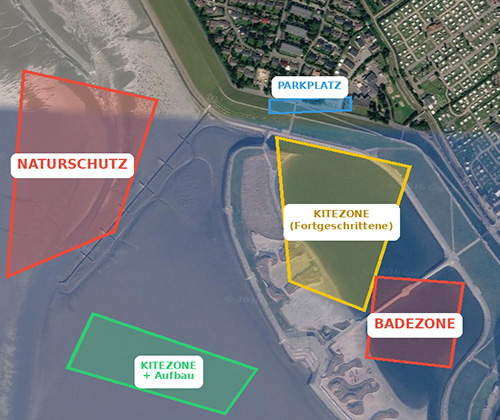
| Directions | Take the A23 towards Heide, then the B203 to Büsum. Approx. 1.5 hrs from Hamburg, around 1.5 hrs from Kiel, a good 2 hrs from Flensburg. At the spot, head towards "Familienlagune"/"Surflagune" (signage is patchy, use the high-rise as a landmark). |
| Wind | All westerly directions, plus south and north. In east winds, head to the nearby fallback spot Deichhausen. |
| Level | Beginner to pro (lagoon: VDWS Level 5 and up) |
| Facilities | Watersports centre at the Perlebucht with a school and up-to-date gear rental, sun terrace, bistro and beach bar. Several campsites and hotels within walking distance. |
Kitesurfing in Cuxhaven / Sahlenburg
A tidal-flat spot at the mouth of the Elbe. A waist-deep all-round spot, usually more relaxed than SPO. Where the Elbe estuary meets the open North Sea lies Sahlenburg, one of Cuxhaven's two main spots. The area is broadly waist-deep and switches between flatwater and chop, solid conditions for every skill level and usually less crowded than St. Peter-Ording. Sahlenburg is also known for the autumn "Hängt-ihn-höher" contest, which draws the big air crowd.
At this spot it's all about the tide: it's rideable roughly three hours before to three hours after high tide, and it gets very shallow in the last hours, with the water never any deeper than hip height. The bottom is hard, so be careful when you crash. And factor in that you'll get dirty crossing the mud and that it smells a bit, which comes with the territory at a tidal-flat spot. One upside of the tide dependence: when high tide falls early in the morning or in the evening, the spot is often nice and empty.
The kite zones matter here: in Sahlenburg the permitted area lies between the groynes of the dog beach, marked off by white and yellow buoys. The swimming area and the adjacent nature reserve are strictly off limits. You may only launch and land roughly four hours before to four hours after high tide. In east winds the locals move to the nearby Kugelbake, but that's where the Elbe's international shipping channel runs. Here you need to watch out twice over: for the big ships and for the sometimes strong current.
| Directions | Take the A27 to the Altenwalde exit, then head towards Sahlenburg/the spa districts to the surfer car park at the beach. Approx. 1.5 hrs from Hamburg. Note: the final stretch runs through a home zone/pedestrian area, so walking pace only here. |
| Wind | Good in southwest and north winds; a direct west wind is onshore. For east winds, switch to the Kugelbake. |
| Tides | Rideable roughly 3 hrs before to 3 hrs after high tide, launching/landing only approx. 4 hrs before to 4 hrs after high tide. Water never deeper than hip height, hard bottom. The tide calendar is a must. |
| Level | Beginner to advanced |
| Facilities | Kite school right at the spot, gear rental, toilets. Large set-up area on the beach and a pack-down meadow. Car park at the beach (€6/day), campsites and accommodation nearby. |
Which forecast works best on the North Sea?
On the coast, a single model is rarely enough, so the pros compare several sources. Windguru has proven itself as a base, because it lets you compare different models directly side by side. For our region the high-resolution ICON-EU model from the German Weather Service (DWD) is particularly strong, often capturing coastal effects better than the global GFS (around 13 km resolution). Windfinder and Windy are good for cross-checking.
But no model replaces a look at the details: don't just watch the wind strength, but also the direction, gustiness and above all the tides, since at all three spots the tide decides whether you get on the water at all.
Frequently asked questions about kitesurfing on the North Sea
Where is the best kitesurfing on the German North Sea?
The best-known kite spots on the German North Sea are St. Peter-Ording, Büsum with its Perlebucht and Cuxhaven-Sahlenburg. All three offer large standing areas and suit everyone from beginners to pros, depending on the spot and conditions.Where can I learn to kitesurf on the North Sea?
The best places to learn are the large, waist-deep areas that appear at low tide, for example in Büsum right in front of the kite school or in Cuxhaven-Sahlenburg. Böhler beach in St. Peter-Ording, with its wide standing area, is also a good choice for your first metres. All three spots have kite schools offering beginner courses. The Perlebucht lagoon in Büsum, on the other hand, is reserved for advanced riders (VDWS Level 5).Which wind forecast is best for the North Sea?
Windguru has proven itself as a base, especially the high-resolution ICON-EU model from the German Weather Service (DWD) for coastal forecasts. Windfinder and Windy are good for cross-checking. In the end, though, wind direction, tides and local experience are what count.Do I have to watch the tides when kitesurfing on the North Sea?
Yes, absolutely. Every spot on the German North Sea is tide-dependent. In Cuxhaven-Sahlenburg, for example, you can ride roughly three hours before to three hours after high tide. Checking the tide calendar before you set off is always part of it.Conclusion
Whether it's the mirror-flat lagoon in Büsum, the versatile classic SPO or the relaxed tidal-flat spot in Cuxhaven, the German North Sea has the right spot for every mood. Stick to the kite zones, plan around the tide calendar and compare a forecast model or two. Then all that's left is: check the wind, pack the kite and go.

You have no product(s) in you basket.
Weet je niet waar je moet beginner?
Contact our customer service for advice
