

Power kiting: what it is and how to learn it
17.11.2026
Written by Benjamin, part of the Kitemana team since 2024.
Power kiting is flying a kite with so much pull that you really feel the power of the wind in your arms. All you need is a power kite, an open space and wind force 2 to 4, and you'll have the basics down in an afternoon.
| Wind | Force 2 to 4 is ideal to start with. |
| Spot | A wide beach or a large field, with no obstacles and few people. |
| Learning | You'll have the basics down in an afternoon. |
| Age | From about 8, with a small kite and under supervision. |
| You need | A power kite or trainer kite with a bar or handles. That's it. Our power kites page shows which size suits your weight. |
What is power kiting?
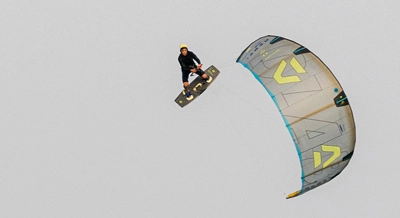
Power kiting is a sport where you control a power kite with a bar or two handles and use the pull of the wind to play, jump or get dragged along. Unlike a normal kite, a power kite pulls hard, and the more wind there is, the harder it pulls. That makes it more of a sport than a game.
Lots of kiters use power kiting as a stepping stone to kitesurfing, but it's a fun activity in its own right too, for example on a family day or a day out with friends. You'll find the different types among our power kites.
Where can you go power kiting?
You can go power kiting anywhere with lots of space and few people, like a wide beach or a large field. Many beaches allow it, but in the swimming season there are often restrictions, for example on busy stretches or at certain times. So always check the local rules or ask the lifeguards.
Checklist: is this a good spot?
- Open space: no trees, buildings or dunes nearby. Behind them the wind is turbulent.
- Room downwind: keep at least two line lengths clear on the side the wind blows towards.
- No obstacles: stay away from roads, car parks, power lines and airfields.
- Few people: never fly the kite over people.
How much wind do you need for power kiting?
For power kiting you need wind force 2 to 4, and as a beginner you're best off practising in that wind before taking on a proper autumn storm. Watch the direction too. Wind coming off the sea (onshore) or blowing along the beach at an angle is steady and even. Wind coming over land (offshore) is gusty and blows your kite towards the sea.
| Wind force | Knots | What do you notice? |
|---|---|---|
| 1 | 1–3 | Too little wind: the kite won't stay up. |
| 2–3 | 4–10 | Ideal to start with: calm and easy to steer. |
| 4 | 11–16 | Plenty of pull, still fine for beginners. |
| 5 | 17–21 | Strong: only if you have the kite well under control. |
| 6 and above | 22+ | Too much for most people: leave the kite in the bag. |
Check the forecast before you go and pay special attention to the gusts. An average of force 3 with gusts of force 5 feels very different from a steady force 3.
How do you learn power kiting?
The quickest way to learn power kiting is in five steps: understand the wind window, lay out the kite, launch gently at the edge, steer, and land safely again.
- The wind window: stand with your back to the wind. The area in front of you, from left to right and from the ground to straight above your head, is the wind window. The kite pulls hardest in the middle, and least at the edges and directly overhead.
- Laying out: put the kite on the ground with the back facing the wind and put some sand on it. Unroll the lines towards the wind and check they aren't crossed.
- Launching: launch the kite at the edge of the wind window, where it pulls little, and let it climb gently to above your head.
- Steering: practise overhead and at the edges, and only steer the kite through the middle once you feel confident. Try flying sideways figure eights: that builds power evenly.
- Landing: steer the kite to the edge of the wind window and let it drop gently there. Put some sand on it straight away or wind up the lines.
Not sure you can do it on your own? Take a lesson at a power kite school, or practise with someone who already kites.
How do you stay safe while power kiting?
Staying safe while power kiting comes down to one thing: you always have to be able to let go of the kite without anything going wrong. These five rules keep you and the people around you in one piece.
- Use the wrist straps or the safety leash. That way you can let go of the kite without it flying off.
- Don't fly in thunderstorms. Or in wind that's too strong or very gusty.
- Wear gloves and sunglasses. In strong wind and on a landboard, add a helmet.
- Never wrap the lines around your hands or fingers. In a gust they cut in.
- If in doubt, let go. A kite can be replaced, you can't.
What comes after power kiting?
After power kiting you can move on to landboarding, snowkiting or kitesurfing. Because you already know the steering and the wind window, you'll pick up those sports a lot faster. Want to go kitesurfing? Then take lessons at a kite school first. Once you're ready for your own gear, our guide helps you choose your first kite.
Frequently asked questions
Is power kiting fun, and is it hard?
Power kiting is fun and not hard: most people can keep a power kite in the air after half an hour of practice. The fun is in the power. Steer the kite through the middle of the wind window and you feel it pull, sometimes dragging you a few steps. After that you can make it more exciting with small jumps or a landboard.
What age can you start power kiting?
Children can start power kiting from about 8 years old with a small kite, in light wind and always supervised by an adult. Manufacturers give a minimum age per model, so check that too. For young children a small kite with handles or a small bar works best, and an adult is best off flying along or launching and landing the kite.
Can you go power kiting in winter?
Power kiting works all year round, and autumn and winter often bring good wind. Do dress warmly, because the wind makes the beach feel a lot colder. If there's snow, you can also use a power kite for snowkiting on skis or a snowboard.

You have no product(s) in you basket.
Not sure where to start?
Contact our customer service for advice
